Showing posts with label Yellowstone. Show all posts

Tuesday, July 29, 2008

The Elusive Moose

Like any good trip leaders getting to know their clients, Peg and Ellie asked us during our first dinner together what -- aside from wolves -- we were hoping to see while in Yellowstone. I had learned from past experience that hanging the success of a trip on one species, especially an elusive, predatory, keystone species like the wolf, risked disappointment. So Trish and I had done enough research to know that even if wolves didn’t show up, we would see plenty of other wildlife: sightings of bison, coyotes, and elk  were high on our wish list.


And I really, really, really wanted to see a moose.


Despite numerous weeks of summer childhood vacations in prime moose country in Maine and the Upper Peninsula of Michigan, and more recent trips to Alaska and British Columbia, I had never seen one, although not for lack of trying.


I got hooked on the notion of meeting a moose when I was about ten. Our friend and neighbor Marty Smith had spent quite a bit of time backpacking in the Maine woods, and he told a wonderful tale of awakening early one mornings to the wet snorting sounds of some wild animal snuffling the sleeping bag he had pulled up over his head (he hadn’t bothered with a tent).


Terrified that it was a bear, although they were rare in that area in those days, he had remained motionless, playing dead. The snuffler retreated a short distance, then began chewing something. Overcome with curiosity, Marty had eased open his sleeping bag, slipped on his glasses, and found himself almost nose-to-nose with a browsing moose. 


Since being trampled by a startled moose (females can grow to 800 pounds, and males weigh in around 1100 pounds) would be every bit as painful and potentially lethal as tangling with a black bear, Marty went back to playing dead until the moose moved on.


After hearing Marty’s tale, I spent every hour our family drove through woodsy and marshy areas of Maine during our vacations with my window plastered to the nose, scanning for the big brown frame of the largest member of the deer family, but to no avail. 


So one of the hopes I brought with me to Yellowstone was that of seeing a moose. Peg and Ellie thought they could deliver; they had seen one almost every morning on their way into the park with the group they had led the week before.


And so every morning, on the drive down from Cooke City into the Lamar Valley, whichever naturalist was at the wheel of my van would drive slowly, everyone scanning the woods that grew right to the road’s edge for the silhouette of the elusive creature.


Unlike the elk and bison we saw in abundance, moose are largely solitary. You’ll find mothers with calves, but adults are not likely to hang out together except during mating times. 


Although their long legs let them navigate the deep snow, they lack the bison’s strong neck muscles for plowing snow out of the way as they search for food. Instead, when the snow starts to pile up, they abandon the willow thickets lining the streams and rivers of the park in favor of the surrounding fir-blanketed mountains. There the canopy of the subalpine fir and Douglas fir trees shades the snow and keeps it from forming the icy crust that would impede a moose’s movements. 


The moose’s solitary nature and penchant for wintering in the deep shadows of a fir forest makes them darned hard to spot, and day after day passed with no sign of a moose.  On the last morning we would spend in Yellowstone, Ellie drove our van at a crawl, determined to find me a moose. 


As we neared the elevation line below which their subalpine pine habitat does not grow, I was steeling myself to once more leaving prime moose territory without having actually seen one of the magnificent creatures, when movement in a relatively open meadow across the road caught our attention. Ellie pulled over with a whoop of triumph, and we all pointed our cameras and clicked away at my elusive moose.


It was a good-sized female wading belly-deep in snow perhaps 30 feet from the edge of the road. Small fir saplings and other edible plants poked out of the deep white blanket all around her.


She leaned forward, reached out with prehensile-looking lips, and chomped onto a branch. With one smooth movement she dragged her  rubbery lips along the length of the branch, denuding it of needles. She calmly chewed and swallowed, looked over at our van, and moved onto the next branch. With the efficiency of a silent woodchipper, she stripped every branch within reach of her long neck, and then moved on to another spot where the tops of several other saplings thrust through the snow.

She moved with the loose-jointed gait of a marionette, picking up each long leg and swinging it through the snow, leaving a track of deep holes connected by shallow grooves behind her. I was fascinated by the articulation of her rear knees, which bent backwards, like a flamingo’s.


We cautiously opened the van’s doors and quietly approached the berm of snow the plows had built up over the winter, crouching down to use it and the scattered bushes for cover as we approached her for closer views. In the snowy silence we stood listening to her snuffling breath and the ripping noise of needles being scraped off of branches until we grew so cold our nostrils pinched with frost. 


It wasn’t even 9 a.m. as we climbed back into the van and dropped down towards the Lamar Valley, but the day had been a wildlife-watching success for me already: I had finally bagged my moose!

Tuesday, July 22, 2008

Puppies Playing in the Snow

One day we spent hours watching the Slough pack wolf pups playing. They had staked out a resting spot between two beautiful pine trees high on a snow-covered ridge. The spot was about three-quarters of a mile from the road, so we had a good view of their antics with our tripod-mounted spotting scopes and binoculars.

The area between the trees was flat, dirty, and snow-trampled. When we arrived and trained our viewing apparatus on the spot, the wolf pups were curled up napping, looking like a scattering of black and gray and grayish-brown boulders. Just watching them lying in the snow gave me the shivers, although I knew their thick coat with its guard hairs was keeping them nice and warm – the cold dampness of the snow would never reach their skin. They had been born in March, which happened to be the same month my Irish Water Spaniel puppy Boomer had been born, and Peg estimated that they were about Boomer’s size as well – some 60 pounds each, and a little taller than two feet at the shoulder.

As we watched, one of the pups uncurled from its nose-under-tail napping position and did a yoga-like stretch to unkink everything from neck to tail. Then in sauntered through the snow and pounced unceremoniously on one of its snoozing siblings.

The snow exploded, and the intertwined pups rolled together like a couple of Hollywood stuntmen down the steep slope, creating a miniature avalanche. One of them broke away and tried to scramble back up the slope, but was brought down from the rear by the other, and they tumbled further down the incline, nearly vanishing in the deep snow.

Their siblings were awakened by the tumult. A couple of them uncurled just enough to sit up and watch their siblings’ antics. I wondered if they wanted to join in, or were watching to make sure they didn’t become the next target.

I had read that the alpha male and female were the only pair in a pack to have young, and that all of the other adults and subadults in the pack would participate in raising the litter: hunting for them, playing with and teaching them, and even babysitting for them. I was hoping to catch a glimpse of the “auntie” or “uncle” in charge of this wild bunch, but all of the wolves we saw were about the same size, meaning they were part of the litter.

The two wrestlers made their peace with each other and began working their way back up the slope to the level resting area. A trio of the other pups stood up and sniffed noses and wagged tails, then vanished over the crest of the ridge. Peg and Ellie had been betting that there was a kill from last night’s hunt just out of our sight up there.

Sue enough, one of the pups reappeared in a few minutes later dragging what looked like a tree branch through the snow. Viewed through binoculars, the long brown object was a meaty haunch of elk, and it left a trail of blood as it was dragged through the snow.

One of the wrestlers had been resting beneath a tree; it now bounded over to its sibling and grabbed the trailing end of the haunch, dashing away with a flap of skin before the haunch’s owner could mount a proper defense. Another sibling came bounding over, but the haunch’s owner dropped its prize and stood four-square over it, snapping and snarling and lunging at the interloper, who beat a comically hasty retreat.

The haunch owner dragged its prize close to the left-hand tree’s trunk and settled down for a feast. A couple of other wolves came up over the top of the ridge, their muzzles and chests looking a bit dark, as though stained with blood. Some of their siblings exchanged sniff greetings and then disappeared over the ridge themselves, presumably to pick at the remains of the feast.

There was so much coming and going over the ridge, and so much wrestling and play-bowing and chasing through snow-banks, that we never did get an accurate count of those wolf pups. In the months after I got home, I watched Boomer put on another ten pounds and grow a couple of inches longer. And although he’s quite large for an Irish Water Spaniel, I still think about those wolf pups, which have doubled in size my encounter with them.

Tuesday, July 8, 2008

Howling in Yellowstone

When I began researching our trip to Yellowstone, I realized that one big difference between this trip and some of the other wildlife-watching adventures Trish and I have shared was how close we could get to the animals. In British Columbia, we had experienced orcas swimming past our inflatable dinghy so close it seemed we could lean out and touch their six-foot-high dorsal fins, and had them dive right under our boat. On that same trip we had (accidentally) gotten within fifty feet of a grizzly sow teaching her second-year cubs to fish for salmon. In Laguna San Ignacio in Baja, Mexico, our 14-foot wooden boat had been bumped by numerous gray whale mothers and calves, and we had leaned over the gunwales to pet several of them.

But wolves are different, their curiosity tempered by wariness. They do not seek out human company, and if they discern with their superhero-like senses that humans are in an area, they simply avoid it. They undoubtedly come close from time to time, but they are so stealthy and so incredibly well-camouflaged that we mere humans with our blunted senses don’t have a hope of realizing they are near.

My research told me that the closest we were likely to get to our quarry on our Yellowstone wolf-watching expedition was a half-mile, and that a distance of a mile or two was a far more reasonable expectation. So we braced ourselves for the seemingly inevitable disappointment of seeing wolves a mile or more away, assuming that such a distant encounter could not have the magical quality we had experienced at close quarters.

We were wrong.

As Peg explained to us on our first day, the easiest way to spot wolves was to spot people who were already watching wolves. And even in the dead of winter, when the light lasts for less than ten hours, the temperature averages less that 30 degrees F, and more than a foot of snow accumulates each month, there are people watching wolves. Many of them are research biologists, some involved with wolf studies that have been ongoing since the first wolves were reintroduced to Yellowstone at the beginning of 1995. Other wolf watchers are film makers working on nature documentaries, local citizens who can’t get enough of the magnificent carnivores in their midst, park staffers who spend all their free time following the wolves the way Brits follow royalty, and tourists like us from all over the world.

Our first glimpse of wolves was indeed from over a mile away, parked in a turnout that overlooked the Lamar River valley. Across the river and beyond the open valley lay a thin forest of winter-nude trees, and with a lot of coaching from Ellie and Peg, I finally discerned movement at the foot of the trees: a small pack of wolves skirting the woods, on the move in single file, dressed in shaggy coats of white, gray, brown, and black that made them look like moving boulders, patrolling their territory.

Yellowstone National Park covers more than 3400 square miles and, according to http://www.yellowstone-natl-park.com/facts.htm, is bigger than Rhode Island and Delaware combined. In 1995, 14 wolves were brought in from Canada at the start of the reintroduction process. In 1996, another 17 Canadian wolves were brought in, and then ten orphaned wolf pups from a naturally recolonizing pack in Montana were added to the mix. These wolves were kept in large pens in various parts of the park for about 70 days for acclimatization. When the pens were opened, the wolves took off into the wilderness and each pack staked out its own territory.

The Lamar Valley, through which runs the plowed State Road 212 that we drove back and forth along every day we were in the park, is divided into the territories of several packs, including the Slough Pack, the Druid Pack, the Leopold Pack, and the Rose Creek II Pack. (You can see the known pack territories as of 2003 at http://www.forwolves.org/ralph/yellwolfmap-latest.htm) These territories butt right up against each other and any wolf crossing the boundary into another pack’s territory is likely to be driven out and perhaps mortally wounded in the process. A large and stable elk population seems to attract and keep so many wolves in the Lamar Valley; during the winter in particular, the snowfall in that area is lighter than in some parts of the park, and the elk flock to the Lamar Valley as a result.

The Mollie’s Pack, on the other hand, has a slightly larger range in the central part of the park that overlaps the park’s eastern boundary. This area is isolated from other packs, but it’s also subject to heavier snowfall, meaning that the elk tend to leave during the winter. And so the Mollie’s Pack is one of the few that has adapted to hunting bison, which remain in the deep snow areas.

The packs change in size, composition, and territory over time; some packs die out altogether, and a new one forms when a few youngsters splinter off from the pack of their birth and head out on their own. Lone wolves, both male and female, will occasionally move between packs in the search for a mate.

We caught sight of one such lone wolf out in the Lamar River valley. Rangy and wary, with a shaggy gray coat and eyes that made a shiver run down my spine even when viewed through the safety of a spotting scope, he was working his way west down the valley. He paused now and then and threw back his head; in the snow-shrouded stillness, his howl reached us a couple of heartbeats later. Each howl was answered by a howl from another wolf on the hill behind us, which stayed on the far side of the ridge, making it impossible for us to see.

We got into the van and moved west with the gray wolf to continue observing it. At one spot where we got out of the van and turned all of our cameras and binoculars and telescopes on the loner, he stood and stared straight at us, not breaking eye contact for at least five minutes. Peg said she thought the wolf was probably looking for an unpeopled spot where he could get across the road – they avoid vehicles and hate to approach the road closely during daylight hours, making most of their kills at night.

When the loner abruptly turned back east, Peg suggested we stay put to give him an opportunity to make it across the road unmolested, and we all agreed. We went to use one of the “comfort stations” at a parking area a little further west, which gave the wolf plenty of time to escape from human attention – it’s amazing how long it takes a line of about a dozen heavily-clothed people to use a one-hole outhouse!

We finally moved the van east and joined a group watching five wolves from the Slough Pack – one gray like the lone wolf we had been watching, and four black – stationed up on the hillside where the answering howls had seemed to originate.

As we speculated about whether this group of five had been the ones answering the loner’s howls, the loner came into sight again, this time on the north side of the road which he had obviously succeeded in crossing, heading cautiously, almost hesitantly up the hill towards the Slough Pack wolves we were watching. Ellie and Peg thought that we might see a confrontation during which the loner would be run off, or possibly even run down, by the Slough wolves. As the loner got within a hundred yards or so, the gray Slough wolf walked down the hill to meet him. Their fluffy flag-like tails were held straight out, and after they went through a sniffing ritual, the gray Slough wagged its tail and turned and romped back to its black-coated friends, with the gray loner close behind.

The black Sloughs did not race down the hill to greet the newcomer, but they did close in around him when he arrived with their pack-mate, sniffing and bowing and wagging tails. After a minute or two of this, they bunched close together and threw back their heads and gave a magnificent group howl. Another shiver ran down my back, and as we wolf-watchers cheered sotto-voce (sound carried so well in the snow-covered hills and valleys that Peg and Ellie were constantly reminding us to whisper so as not to spook the wildlife!) and gave each other mittened high-fives, we were astounded to hear an answering howl from across the river valley.

Louder than the wolves’ howls, this howling was the product of what sounded like at least a dozen separate voices. It went on and on, and open-mouthed, we turned to scan across the road and valley, but couldn’t see the source of the howling. As the howl trailed off it ended with a spree of yips and yaps, like a spectacular Fourth-of-July firework that explodes in a beautiful colorful fountain and then finishes with a succession of small, loud pops. “Coyotes,” Ellie and Peg stage-whispered in unison, and then the wolves on the hill above us sent up their voices in another howl. The coyotes answered, and for another ten minutes or so we stood there mesmerized by the howling volleying back and forth across the valley, wolves challenging, coyotes – growing ever distant – responding.

When the howling was over, Peg and Ellie rounded us up and loaded us back into the vans to warm up, explaining how they’ve had week-long tours where they didn’t hear a single wolf howling. We had been incredibly fortunate to witness such a howl-a-thon.

Tuesday, July 1, 2008

Persistence Personified: The Bison of Yellowstone

Getting ready for my Yellowstone trip, I had been looking forward to seeing bison in their natural habitat. Those I had seen in zoos were unprepossessing specimens that looked small and ragged and smelled bad in their barren enclosures. They did not live up to their American icon status. I had to believe that the bison that had been central to the cultures of so many Native American tribes was majestic and awe-inspiring, and those were qualities I hoped to see by encountering bison in the wild.


On our first day in Yellowstone we came around a bend in the road and there on the left in the snow banks built up at the road’s edge by the plows were EIGHT BISON! Their shaggy brown coats were crusted with snow, and they swung their heavy heads back and forth, patiently scraping away several feet of snow to get at the grasses and sedge under its cover. Their bulging neck muscles, thick skulls, and sturdy legs are made to order for plowing through the deep snow to uncover food. These adaptations enable them to live year-round in Yellowstone and other places where mule deer and less hardy grazers fail to thrive.


Through our driver Peg’s open window we could hear the crunch of snow under their hooves and the snorts, grunts, and sighs they emitted. Clouds of white steam blasted from their nostrils into the freezing air.


Although each paused in feeding to fix our van with a round, brown eye for a moment when we first stopped, none of them seemed at all disturbed. We were so close – half a road-width away, not much more than a bison’s 10-foot body length – that we didn’t dare get out of the van, so everyone with cameras took turns getting up to the driver’s side windows and shooting through them.


The bison of Yellowstone are a true conservation success story. As every child learns in American history, tens of millions of bison roamed the west up until the coming of Euroamerican settlers. Eyewitness accounts preserved in letters and journals describe herds so vast that it took several days and several nights for all of the bison to pass a given observation point. During the mid and late 1800s they were slaughtered wholesale, and by the end of the nineteenth century only a few dozen remained. Almost two dozen of those lived in Yellowstone National Park, which was an American experiment when it became the very first national park in the world in 1872. In the park they were protected, but their numbers grew slowly. In the early 1900s, more bison were brought in from privately owned herds, and the population grew more rapidly.


During the early half of the 20th century, the bison were managed aggressively: bred, herded, relocated, protected from predators, and culled. In the mid-1960s the park supposedly backed off of such aggressive herd management and allowed nature to take its course; the official party line is that natural ecologic processes now control the number and distribution of bison within the park. And the official population numbers look impressive:
· 1902: less than two dozen
· 1954: 1500
· 1996: 3500
· 2005: a record summer population of 4900
· 2006: a summer population of 3900
· 2007: a late-winter (February) population of 3600
· 2007: a summer (July-August) population of 4700
· 2008: as of April 15, the population dropped to 2100
Although the general upward trend in the bison population seems like something to celebrate, the last bullet in the list above illustrates the downside: increasing numbers of bison wander beyond the boundaries of the park in search of food. Because the bison carry a disease called brucellosis, which might be picked up by domestic cattle, bison that stray outside of the park are “hazed” or harassed by park workers and employees of state and federal agencies in charge of bison management. The hazing includes buzzing the bison by helicopters and chasing them on snowmobiles, horses, and ATVs, using the noise of the machines to drive the bison back into the park.


Bison that persist in leaving the park in spite of hazing are rounded up, tested for brucellosis, and slaughtered if they test positive. According to the New York Times, nearly 1200 had been slaughtered by March 23 of the 2007-2008 winter, and the killing was scheduled to continue through April. (source: http://www.nytimes.com/2008/03/23/us/23bison.html?pagewanted=1&_r=1) This culling of the herd supposedly protects the interests of area ranchers by keeping Montana brucellosis-free, but it’s an issue fraught with emotion on both sides. In at least one of the areas where the bison were hazed and captured for slaughter, there were no cattle present, and the owners of the land apparently had no problem with the bison being there. (source: http://www.buffalofieldcampaign.org/media/press0708/pressreleases0708/052908.html)


In the winter of 2007-2008, a total of approximately 1700 bison died (source: Jackson Hole Daily article http://www.jhguide.com/article.php?art_id=3078); the 500 or so that were not killed by humans were victims of winterkill, which is the toll that extreme weather and harder-to-reach food takes on the less fit animals. Surprisingly, the reintroduction of wolves hasn’t taken much of a toll on bison. Only one of the park’s dozen or so packs “specializes” in hunting bison by running them down in deep snow, and even they don’t take that many of the great beasts.


Probably because bison bulls can weigh 1800-2000 pounds, and even the slightly less massive cows (they’re not exactly diminutive at 1000-plus pounds) stand six feet tall at the shoulders. And not only does one bison feed a lot of wolves and other carnivores and scavengers for long time; their curved, pointed horns are quite deadly and are not shed every year like the antlers of elk and deer. Bison can move at 30-35 miles per hour in short bursts, and park regulations advise people to stay at least 25 yards from them and all other wildlife in the park (except bears, which rate a minimum distance of 100 yards, but which were hibernating soundly in their dens during our Yellowstone sojourn).


Peg, behind the wheel of our van, had all of this in mind and kept the engine running, ready to make a quick getaway if the small herd of bison we had encountered decided it was time for us to move along.


Their massive heads dipped down, swung left and right and back again, and then came up with white-coated fodder hanging from their mouths. Wise brown eyes looked into our faces and camera lenses. The great mouthfuls disappeared with a couple of movements of the massive jaws, and the heads dipped down again for another go. Our cameras clicked and buzzed and beeped. Our voices were hushed with admiration as we said “wow” and “amazing” and felt ourselves in the presence of ancient wordless wisdom.


We moved on after about ten minutes of watching these majestic animals go about making their livelihoods in their patient, dignified way, but we saw bison again and again throughout our days in the park. Usually they were in the distance, often mere dark dots moving through the deep snow in single-file lines that stretched for several dozen creatures.


One morning, dropping down into Lamar Valley from Cooke City, we found a lone bull grazing in a quiet pocket-sized meadow. It was about fifty feet away, armpit-deep (do bisons have armpits? Legpits?) in drifted snow, its muzzle crusted with a layer of white every time its head emerged with a mouthful. Peg pulled the van over. When the bull seemed undisturbed, we quietly opened the sliding side door. After ascertaining that the bull still didn’t mind our presence, I slid down to kneel just outside the door in the snowbank, glad I had invested in really thick quilted snowpants. Behind me the rest of the group clustered in the door, cameras shooting over my head as we gazed silently at the majestic grazer.


I have a friend who considers the bison his “spirit animal” because he admires their patience, their fortitude, their ability to keep putting one foot in front of the other no matter what Mother Nature throws at them. To remind him to “keep on keeping on” even in the toughest of times, a silhouette portrait of a bull, muzzle crusted with snow, eye gazing wisely at the camera, breath forming a cloud around its curved horn, hangs in his family room.


Having finally met the bison in the wild, I understand why.


A number of organizations are campaigning for less deadly bison management strategies in the greater Yellowstone area, including The Humane Society, Defenders of Wildlife, and the NRDC. Check their web sites and search for “bison” to get the latest information and find out how to get involved.

Tuesday, June 24, 2008

Stories in the Snow: Winter in Yellowstone 2007

[In January 2007 my friend Trish and I spent several wonderful days in snow-shrouded Yellowstone National Park, hoping to see wolves. Here's a post about the first day of our trip.]


I grew up mostly in Connecticut and Wisconsin, and I moved to Northern California more than twenty years ago largely to escape cold weather. I don’t like snow, and I despise ice, which made the sidewalks and roads of my childhood impassible, broke branches off my favorite climbing trees, and knocked out electrical service for days at a time. The mere sound of wind whistling past the window gives me goosebumps, and a radio announcer reading out the wind chill numbers in predawn darkness brings back the worst memories of my teenage years. My extended family still lives in and around Madison, Wisconsin, but they have gotten used to not seeing me during any month that snow might fly.

They’ve also gotten used to my predilection for chasing wildlife all over the world. So they were not surprised to hear that I was planning a vacation to Yellowstone National Park. They were not surprised to hear that my main objective was to spy upon and if possible photograph the wolves that were reintroduced to Yellowstone in 1995 and 1996 with great international fanfare and more than a little protest.

They were a little surprised by the time of year I was going, though. “January?” My grandmother asked on the phone after a pause, perhaps wondering if she had heard me right. “But, Jen, what about the snow?”

It had taken my friend Trish, who is usually my “wingman” on land-based wildlife-themed adventures, a couple of years of talking to get me past the snow. The wolves of Yellowstone, it turns out, are best seen in snowy conditions. They don’t particularly like getting close to people, so the more people there are – and there are apparently a lot of them in Yellowstone during the non-winter months, judging from the photos of traffic tie-ups on the main park roads I saw – the less visible the wolves are. Their coloring, which varies from white to gray to black to brown to gold and sometimes combines all those shades in one pelt, helps them vanish into the background of the magnificent Yellowstone countryside. They stealthily move through the lush and thick tree and brush cover from spring through fall.

Couldn’t we go in really late fall, I had countered when she showed me the catalogs of black wolves staring majestically down from what looked like 20-foot high snowbanks, when the leaves had fallen off the trees but the snow was not yet on the ground? Or maybe really early spring, when the leaves were still curled in their buds?

But, no, more research revealed that Trish had it right: our best opportunities to view wolves in the wild would be when the park was shrouded in snow and there were only a few really dedicated researchers and really crazy wildlife watchers on the ground. So I signed up for the tour and booked my flight to Bozeman, Montana. Then I trekked off to REI to buy out their long underwear department, hit up another sporting goods store for a pair of insulated ski pants that made feel like a Michelin woman, and found waterproof, double-insulated snowboots, quilted gloves, and a matching parka at Lands End.

And so on the afternoon of January 21, 2006, Trish and I stood at the window of our hotel room in Gardiner, Montana, staring across the Yellowstone River at an elk walking down a neighborhood street. It meandered through one yard after another, browsing brown-looking tufts of grass or sticks that poked through the snow pack, ducking its huge antler rack to go under a clothesline here or maneuver around an ornamental tree there.

Gardiner is a little city just outside of the North Entrance of Yellowstone National Park, and Trish and I and the dozen other tourists who comprised our tour arrived there by shuttle bus from Bozeman in the fading afternoon light. Between the early darkness, the freezing weather, and the fact that Trish was in the throes of a horrible cold-flu bug (which I of course would get as the trip unfolded), we were not inclined to do much exploring. The glimpses I caught through the bus and van windows as we shuttled through the little town showed buildings with a very Wild West look to them, and there were some inviting-looking galleries and restaurants that I hope to return to sample during warmer weather someday.

That night, the lone elk was the only sign of life I saw outside of the Wild-West-Saloon-Style restaurant where our naturalist guides, Peg Abbot and Ellie Van Os, took us for our getting-to-know-you dinner. We sat around eating warm and welcome comfort food and introducing ourselves, talking about where we lived and worked and comparing notes about other natural history tours we had enjoyed.

Our group was fifteen travelers, three of them men, mostly from surrounding western states. The exception was James from Scotland, who charmed everyone in the group with his accent and his helpful ways. The next morning we began our wolf hunt after a 6:30 breakfast. We divided into two large white vans that each had three bench seats in addition to the driver’s and front passenger’s bucket seats. All of us were dressed as the literature on preparation for the trip had suggested, in layers of long underwear, jeans, turtlenecks, sweaters, snow pants, and parkas, topped off with warm hats, scarves, gloves, and mittens. Although the benches were wide enough for three people who weren’t bundled up for winter survival, we were glad to be sitting only two to a bench! I was worried that I’d overheat inside the van and end up feeling travelsick, but we stopped and got out of the van so often that the heater never really caught up with us.

As we eased out of Gardiner that first morning, it was clear and cold. We turned into the park and drove through the lovely stonework arch that forms the North Entrance. A herd of bison had been there recently enough to leave a trampled snowy field dotted with piles of dung. “They drive the custodians for Gardiner’s school sports fields nuts during football season,” Peg said.

The roads through most of Yellowstone are closed during winter, but the main artery running through the park from the North Entrance to Cook City just outside of the Northeast Entrance is plowed, and this is where we would be looking for wolves. “We don’t have to leave the road to see them,” Peg and Ellie had explained during our orientation meeting the night before, which had included a post-dinner showing of an old movie about Yellowstone’s natural history. Some of the most successful packs live in and around Lamar Valley in the northeast corner of the park, which the plowed road runs right through. Wolf researchers and tourists alike set up their spotting scopes in parking lots and pullouts up and down the road.

“We’re not looking for wolves, really, we’re looking for signs of wolves,” Peg explained as she drove us through the Park Headquarters at Mammoth Hot Springs, which we would come back to explore later. “Keep your eyes open for black birds congregating around anything out in the snow – magpies, ravens, and vultures are usually our first indication that there’s been a wolf kill. The wolves usually make their kills and do most of their feeding at night around here, but then they often rest not far from the kill, and some of them may come back to the kill to carry away a haunch or whatever. So we may be able to track them from a kill to wherever they are resting.
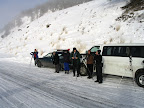
"The other thing to look for is parked vehicles with people staring into the distance using binoculars, spotting scopes, or cameras. Chances are pretty good they are watching wildlife, and if we’re really lucky, they’ll have found wolves.” She held up a handheld two-way radio and explained that she knew a lot of wolf researchers from her years of working in the park when the wolves were first being reintroduced. If we weren’t having any luck, she could monitor the chatter of wolf researchers and check in with them for good wolf-viewing locations, as well.

As we wound down into the Lamar Valley, passing hillside after hillside swathed in snow that was a day or two old, I marveled at all the animal tracks that the white stuff had preserved. I could see the deep, narrow marks in the snowbank where elk had crossed the road and clambered up. They contrasted with the plowed-out paths left by bison whose bodies were like small bulldozers. Then there were small coyote tracks that barely broke the surface, and the delicate foot- and wing-prints of birds.

Peg parked us in a small pullout and led us up the road a short distance, saying, “We saw a lone wolf along the river down there yesterday, and he was coming in this direction. I think I see the tracks where he came up from the river and crossed the road.” She pointed to a narrow set of depressions that ran in a wavering line up from the river valley, and sure enough, we found several clear prints in the thin snow near the road’s edge. I pulled off my glove and spread my fingers above one of them, and was stunned to see that the print was bigger than my palm.

We loaded back into the van and went on, stopping to view a couple of old kill sites – places where wolves had brought down a lone elk some time in the week or two before. All that was left was a skull, a few rib bones, and a curve of spinal column sticking starkly out of the snow. Even the magpies had given up on the site, since it had been stripped of every bit of meat, gristle, sinew, skin, and even fur by the usual succession of visitors to a kill: the wolves who killed the elk as a coordinated group and then ate until their stomachs bulged; followed by coyotes, vultures, and even bald eagles, who would fight over the remaining choice scraps; followed by the ravens and the magpies, who hovered over the kill and darted in to steal scraps from the stronger, fiercer animals as they became satiated. Foxes might sneak in for a bite if they were in the neighborhood at the right time. The coyotes and birds would return again and again, removing the less and less choice bits, until all that was left were bones.

The entire story lay there for the reading in the snow itself, packed down by one wave of scavenger after another. The marks of running elk pursued by loping wolves vanished into a packed-down area formed by falling, rolling, struggling bodies. Blood stained an area where a wolf had pulled away a good-sized chunk of meat and retreated from the pack to eat it in peace. The scattered bones of a rear leg marked where a pair of coyotes had dragged a relatively intact haunch to feast upon. Wolf and coyote and bird tracks overlapped, and the snow was bloodstained, pitted and packed from being trampled repeatedly by every type of scavenger in the park.

We got back into the van and a few curves later came upon a snowy hillside that told a different story: the pell-mell flight of a small band of elk, the faltering steps of one of its members, blood and compressed snow, and then a drag mark leading to a stand of trees.


“That could be a cougar kill,” Peg said as we looked at the marks with binoculars. “That’s one difference between the canids and the big cats. The wolves can eat until they literally look like they’re going to burst – they pack pounds of meat into their bellies in one sitting and have to waddle away when they’re done. The big cats can’t eat like that, they have to eat just a little bit at a time, so they cache their kills, hide them away in a spot like this and guard them, and come back again and again to eat small meals. One kill might last a cougar a week or two if it can keep the carrion from being found by the birds. Once the birds find it, it’s all over with, because they broadcast the news to the world.”

We made a number of other stops along the road that day, pausing to talk to researchers, other wolf-watchers, and filmmakers. We saw coyotes in the distance, several small herds of elk, and a few bison as well. But although we scanned the trees and ridges with our binoculars and spotting scopes, we didn’t come across any wolves before we had to exit the park at the Northeast Entrance and make our way to our motel in Cooke City.


Snowflakes were flying by the time we bundled up for our short walk to dinner at a nearby restaurant, but I didn’t mind. Seeing the stories told by the tracks had given me a new perspective on snow, and I went to bed eager to see what stories a fresh blanket of the white stuff would have to tell me in the morning.